vecta platform
Operations walkthrough
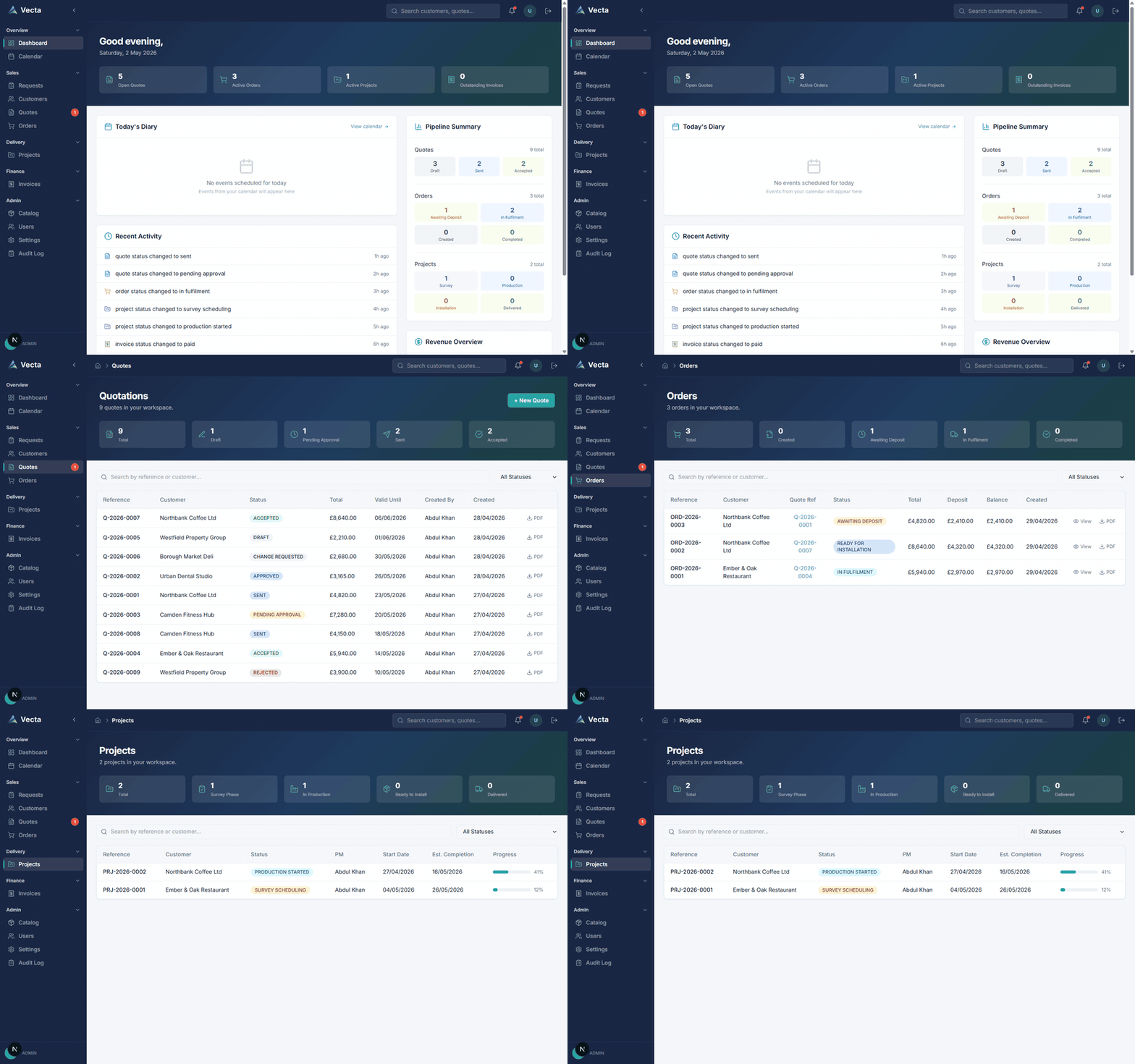
A connected platform view across sales, production, project delivery, finance, leadership, and live field activity.
A connected operations platform that brings sales, production, project management, finance, leadership, outsourced surveyors, and installation teams onto one mobile-first workflow, with Zoho and GoHighLevel integrations helping drive the sales pipeline.
Client
Vecta
Timeline
3-6 months
Delivery
Platform build
Sales and quotation workspace
Finance and order control
The client needed one shared operating view for sales, production, project management, finance, leadership, and external delivery teams, replacing disconnected processes with live, auditable workflow control.
Delivered Vecta as a Turborepo monorepo with a NestJS API, Next.js dashboard, shared enums, Drizzle/PostgreSQL schema, familiar Microsoft authentication, role-based access, quote and order orchestration, customer and contractor magic links, mobile-style site survey workflows, PDF/email generation, payment records, audit logging, and Zoho/GoHighLevel integrations to support sales activity.
Vecta keeps every team on the same page from enquiry to warranty, with controlled quote-to-order and deposit-to-project transitions, live field updates from outsourced surveyors and installation teams, document generation, finance visibility, and a durable audit trail.
Project Screenshots
A connected platform view across sales, production, project delivery, finance, leadership, and live field activity.
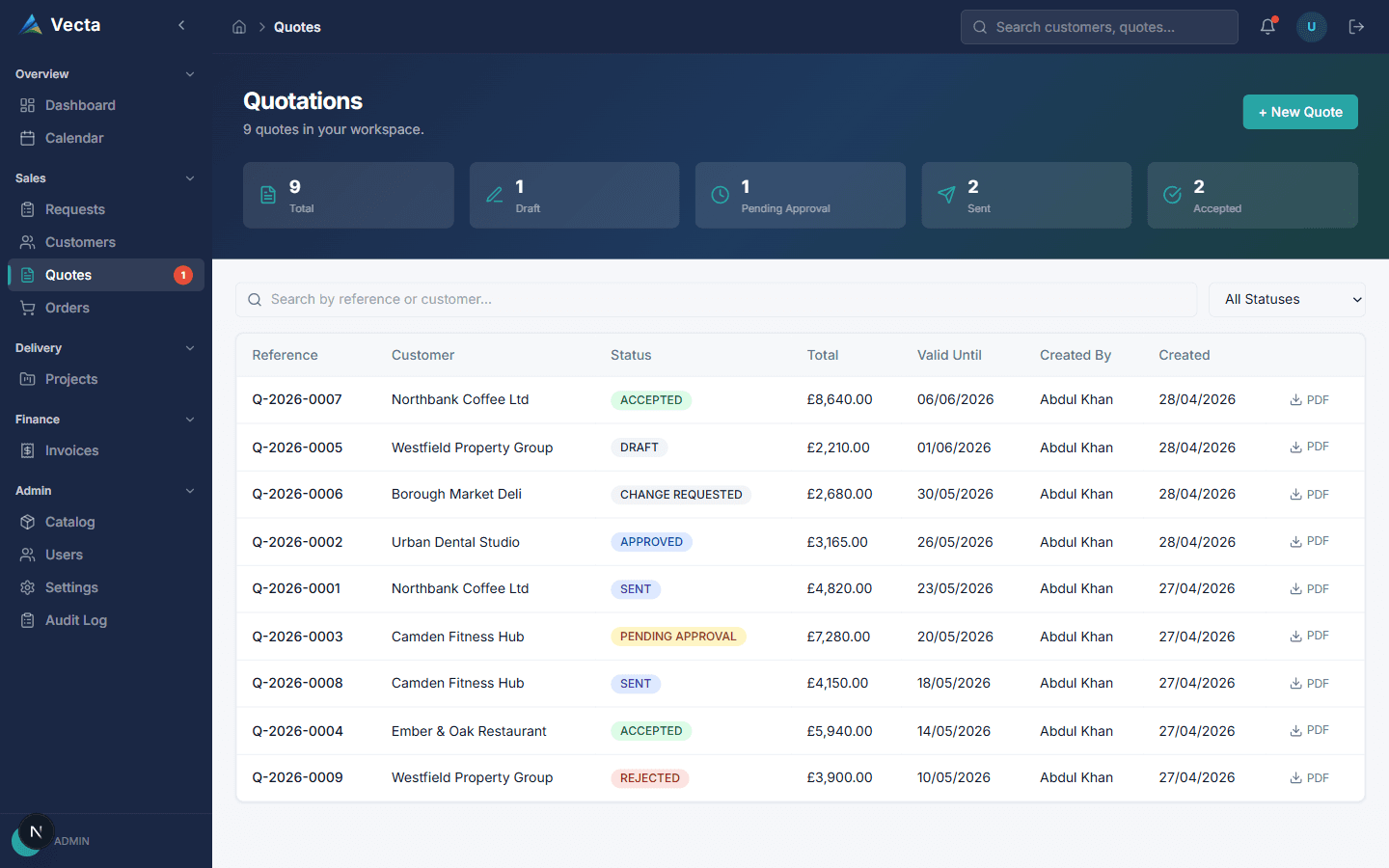
Quote pipeline tracking with approvals, Zoho and GoHighLevel context, accepted work, PDF actions, and status visibility.
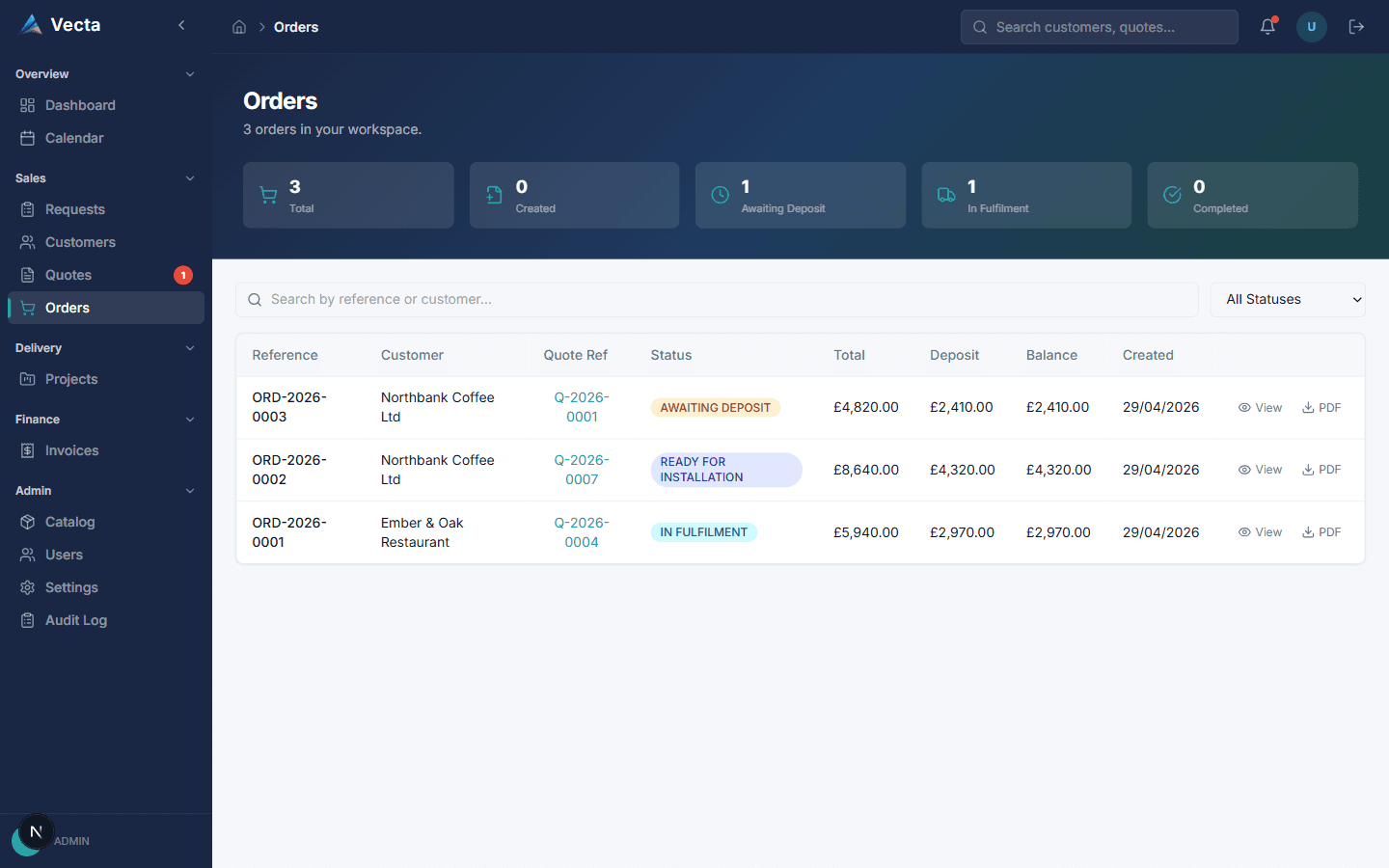
Deposit, fulfilment, balance, and order document workflows visible to sales, finance, and operations.
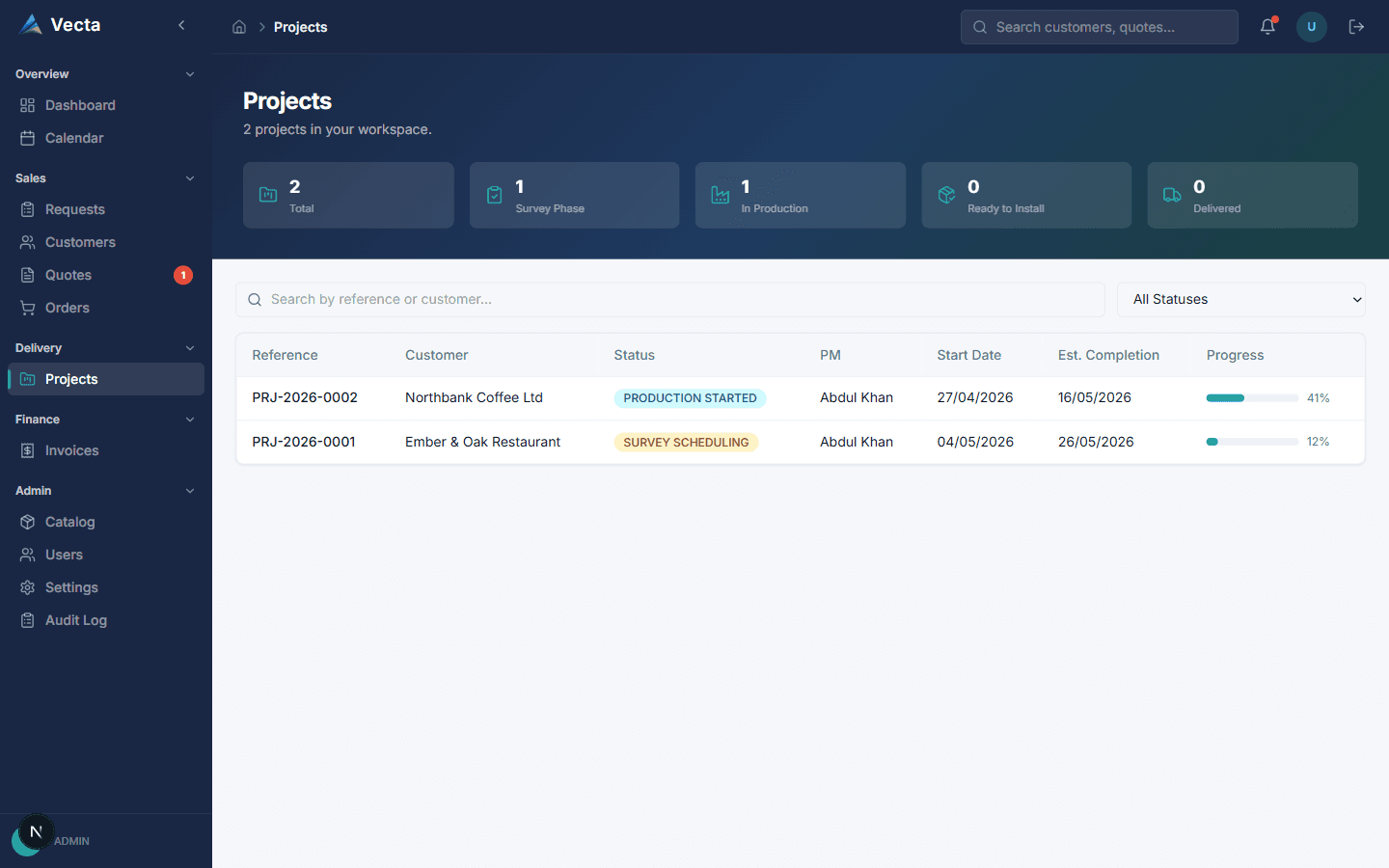
Project lifecycle tracking from survey scheduling through production, outsourced installation, and live site updates.
Delivery Notes
Vecta is a business operations platform for project-led commercial service companies. It connects the sales team, production team, project management team, finance team, and leadership team around one shared view of work in progress.
It was designed around a clear entity spine: quote request, customer, quote, order, project, invoice, payment, and audit trail. The source project is a pnpm and Turborepo monorepo with a NestJS API, Next.js dashboard, shared TypeScript package, PostgreSQL database, Drizzle ORM schema, Microsoft authentication, WebSocket gateway, PDF templates, branded email templates, mobile-style site survey forms, Zoho and GoHighLevel sync workers, magic links, notifications, and role-based access control.
Vecta was built to connect the full commercial and operational lifecycle, not just record it after the fact. Each entity has its own lifecycle, and important transitions are handled by service-level orchestration rather than loose UI actions.
The important principle is alignment. Sales can see what has been quoted and accepted. Production can see what is ready to build. Project managers can track surveys, installation readiness, and delivery status. Finance can see deposits, invoices, and payment state. Leadership can see the same operational truth without waiting for manual updates.
The delivered platform includes:
Website quote request
  -> Vecta API
  -> Quote request
  -> Quote draft
  -> Manager approval
  -> Customer portal magic link
       -> accept quote
       -> decline quote
       -> request changes -> clone revised draft
  -> Accepted quote
  -> Order
  -> Deposit received
  -> Project
  -> Site survey magic link
       -> outsourced surveyor captures live site evidence
  -> Production
  -> Installation magic link
       -> outsourced installation team updates progress from site
  -> Invoice / payment
  -> Warranty
Every critical action
  -> validate current status
  -> check role and permissions
  -> perform transition in service layer
  -> create linked records when required
  -> write audit event
  -> send email / notification when configured
  -> update dashboard and entity history
Project-led commercial service businesses often grow around spreadsheets, inboxes, file folders, and individual memory. That creates risk at the exact points where control matters most: approvals, quote revisions, deposits, project handoff, survey scheduling, installation readiness, customer communication, invoices, and payment records.
The client needed a single system that could make the workflow explicit. A quote should not become an order until it has been accepted. A project should not start from a half-paid order unless the workflow allows it. A survey should not silently change lifecycle status just because an office user resent an email. A customer change request should preserve the original quote, not overwrite history.
The platform also needed to connect outward. Website quote requests, Outlook calendar and email flows, Zoho, GoHighLevel, outsourced site surveyors, installation teams, and customer-facing magic links all needed to feed into the same governed lifecycle rather than creating parallel records. Zoho and GoHighLevel are part of the sales engine: they help drive enquiries, follow-up, and pipeline activity while Vecta keeps the commercial and delivery truth connected.
We built Vecta as a governed operations platform with the rules encoded in the service layer.
The core model links quote requests, customers, contacts, quotes, quote items, quote dimensions, attachments, orders, projects, project assignments, site surveys, survey media, survey measurements, invoices, invoice items, payments, magic links, notifications, integrations, and audit logs.
This gives the business an authoritative record of what happened and why. Entity pages can show related records, status, documents, customer context, linked project state, finance state, field activity, and audit history instead of forcing users to reconstruct the story from separate tools.
Quotes move through draft, pending approval, approved, sent, accepted, rejected, and change-requested states. Sending a quote creates a customer portal magic link and branded email. From the portal, the customer can accept, decline, or request changes.
Acceptance triggers the order creation workflow. Change requests mark the original quote as change requested, revoke outstanding links, clone the quote into a new draft version, copy line items, dimensions, attachments, and record the customer reason for traceability.
Order transitions are controlled. The order moves through proforma, awaiting deposit, deposit received, fulfilment, and readiness states. Deposit receipt and project creation are joined through a transactional orchestration method, so the system does not leave the business with a paid order but no project record.
Final completion is project-owned. That keeps delivery truth inside the project workflow, where survey, production, QA, installation, and warranty activity actually happens.
The project module manages survey scheduling, surveyor assignment, survey magic links, survey request emails, Outlook calendar push, active survey state, live media, measurements, customer summaries, review outcomes, installation progress, and follow-up actions.
Outsourced surveyors can capture photos, videos, measurements, electrics, access notes, site conditions, and sign details from a secure mobile app-style route. Installation teams can be connected in the same way: a magic link gives them the right job context and lets the internal team see live results while activity is taking place on site, rather than waiting for a final phone call or end-of-day email.
Vecta includes audit logging across lifecycle changes and entity updates. PDF generation produces quote, order, proforma, and invoice documents through server-side templates. Email templates cover the core customer and internal communications. Integration modules support scheduled sync and external mappings for systems such as Zoho, GoHighLevel, Outlook, calendar connections, website quote ingestion, and field-team activity. This lets sales and marketing activity continue in familiar pipeline tools while the operational team works from the same quote, order, project, invoice, and payment data inside Vecta.
Vecta now gives the business a connected operating system for sales and delivery. Website enquiries can become quote requests, quotes can be approved and sent, customers can respond through a portal, accepted quotes can create orders, deposits can create projects, and projects can move through survey, production, installation, delivery, and warranty with traceability.
The important outcome is shared confidence. Status is not just a label on a dashboard; it is a controlled contract. Every transition can be validated, every important action can be audited, and sales, production, project management, finance, leadership, surveyors, and installation teams can see the live relationship between quote, order, project, invoice, payment, field activity, and customer communication.
We build systems like this for businesses ready to invest in real engineering. Let's talk about your project.